

A quick reference list of housing, healthcare, and support options forolder adults who do not qualify for Medicaid.
As financial advisors, we see can see certain issues trend among our client households. One topic on the rise is about our aging boomer parents. Aging-related issues are much like financial planning – every family’s situation and needs are so different there is no “one size fits all.” The “how do I help my parents with [fill in the blank],” can range from a simple referral to complex housing and care needs.
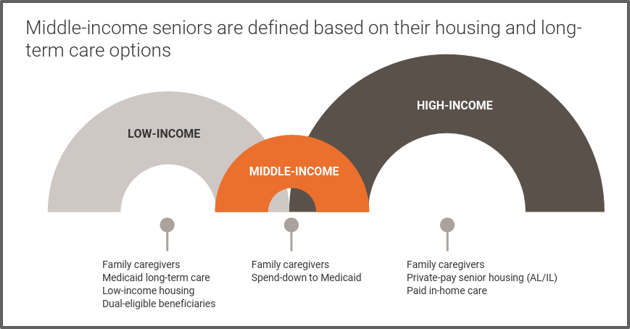
As our parents grow older, their needs around housing and supportive services converge to varying degrees depending on their physical and mental health. For the very poor, the additional services Medicaid provides create a safety net. If your parents are too wealthy to qualify for Medicaid and yet too poor to pay for it all out of pocket, it’s likely that they will have to lean on family members for additional financial help. It is predicted that there will be 16 million middle-income seniors (age 75+) by 2033. With annual incomes and annuitized assets between $24,726 and $74,298, many will not have the resources to afford assisted living when living independently is no longer an option.
Our clients find themselves overwhelmed having to become an expert on all things aging, so this is our attempt at creating a starting place. Below is a quick list of options that do not require Medicaid with definitions, pro/cons and national links (and some Maryland & DC ones as well). Keep in mind that the most effective approach is usually stacking or layering the offerings in accordance with your parents’ needs and the availability in your community/state.
Subsidized Senior Housing
HUD Section 202 – Supportive Housing for the Elderly
A federal housing program that provides safe, affordable housing options for low-income households with at least one adult 62 and older.
The best overall option when available.
For adults 62+ with very low income (generally ≤50% of Area Median Income).
Rent is capped at ~30% of income.
Often includes built‑in supportive services (service coordinators, transportation, meals, wellness checks).
Important:
Section 202 is housing assistance, not Medicaid. There is no medical eligibility test and no asset spend‑down requirement beyond HUD rules.
Reality check:
Waitlists can be 2–5+ years in many metros, so applying early and to multiple properties is essential.
Maryland Resources:
District of Columbia Resources:
Public Housing & Housing Choice Vouchers (Section 8)
Housing in the private market where rent is partially covered by subsidies.
Available to adults of any age, but seniors often receive priority.
Can be used for senior-designated buildings or private rentals.
Income is typically ≤50% of Area Median Income.
Advantages:
Extremely low rent.
Works even when someone does not qualify for Medicaid.
Limitations:
Long waiting lists.
Housing quality and accessibility vary widely by location.
Maryland Resources:
District of Columbia Resources:
Creative & Informal Housing Solutions (Often the Only Option)
These are not formal programs but are commonly used:
Shared housing / roommate matching
Senior‑specific home share programs exist in many cities.
Maryland Resources:
District of Columbia Resources:
Accessory dwelling units (ADUs)
Especially if connected to family or church communities.
Faith‑based housing networks
Churches, Jewish Family Services, Catholic Charities.
NORCs (Naturally Occurring Retirement Communities)
Informal services layered into existing apartment buildings.
Often paired with OAA services to maintain independence.
Support to Help Seniors “Age-in-Place”
Older Americans Act (OAA) Services
Offers many different social and nutritional services to older adults and is one of the most underused lifelines.
Available to adults 60+.
No Medicaid requirement.
No income cutoff (but low-income adults are prioritized).
Services may include:
Meals (Meals on Wheels, congregate meals).
Transportation.
Light homemaker support.
Care coordination.
Caregiver support.
Legal assistance.
Social engagement programs.
Home improvements.
OAA services often bridge the gap for people who are “too poor to afford help but not poor enough for Medicaid.” Use Eldercare Locator from HHS Administration for Community Living.
Maryland Resources:
District of Columbia Resources:
Healthcare Services
Sliding‑Scale Community Health Services
Service costs are income‑based, not insurance‑based. Does not require Medicaid.
Federally Qualified Health Centers (FQHCs).
Community mental health centers.
Dental clinics tied to senior centers or health departments.
They provide:
Primary care.
Behavioral health.
Preventive services.
Maryland Resources:
District of Columbia Resources:
Programs to Reduce Healthcare Costs
Medicare Savings Programs (MSPs)
State help in paying Medicare Part A and Part B premiums. This is extremely important for the “Medicaid gap” population.
Even if someone is denied Medicaid, they may still qualify for:
Help paying Part B premiums.
Reduced out‑of‑pocket costs.
Automatic eligibility for the Extra Help program for prescription drugs.
Income limits are higher than Medicaid, and many states:
Disregard assets.
Apply generous income exclusions.
It is recommended that you apply even if you think you don’t qualify; many people who think they’re “over income” are actually eligible.
Maryland Resources:
District of Columbia Resources:
Increased Health & Support Needs
PACE (Program of All‑Inclusive Care for the Elderly)
A powerful but geographically limited option that does not always require Medicaid enrollment, although most participants are dually eligible for both Medicare and Medicaid.
Eligibility:
Age 55+.
Requires nursing‑home‑level care.
Lives in a PACE service area.
Can live safely in the community.
If a person has Medicare only, they pay a monthly premium and receive:
Medical care.
Prescription drugs.
Adult day care.
Transportation.
Home care supports.
Case management.
This can be a lifeline for someone medically fragile who doesn’t meet Medicaid financial thresholds.
Maryland Resources:
Trinity Health PACE (Montgomery County)
District of Columbia Resources:
Low‑Cost Assisted Living (Limited Availability)
Some nonprofit or faith‑based assisted living facilities:
Use sliding‑scale rents.
Accept SSI income.
Do not require Medicaid at entry.
These are not widely advertised and are usually discovered through:
Area Agencies on Aging (Eldercare Locator).
Elder law attorneys (see Area Agencies on Aging).
Maryland Resources:
Maryland Quality Reporting (information and quality ranking for assisted living, nursing homes, hospitals and hospice)
District of Columbia Resources: